







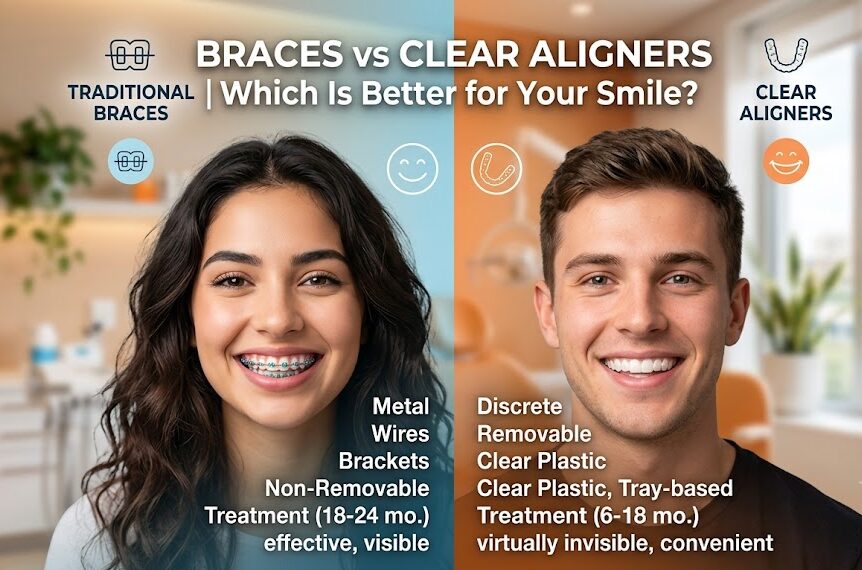
When comparing braces vs clear aligners, the better option is not automatically the one that looks less noticeable or promises the shortest timeline. In general, complex teeth straightening and bite adjustments are reliably managed by traditional braces. Clear aligners offer a discreet, removable option but require consistent daily wear.
Your decision should come down to three questions: What movements do your teeth require? Can you follow the treatment routine every day? What will the complete treatment cost after insurance? A dental examination and diagnostic imaging are needed to answer those questions accurately.
Braces vs Clear Aligners at a Glance
Both treatments move teeth by applying controlled pressure over time. Braces use brackets attached to the teeth and an archwire that guides movement. Clear aligners use a planned sequence of custom trays, with each tray moving the teeth by a small amount. The American Dental Association identifies orthodontic treatment as a way to correct crowded or crooked teeth and bite problems in which the upper and lower jaws do not meet properly.
| Decision factor | Traditional braces | Clear aligners |
| Appearance | Visible metal or tooth-colored components | Transparent but not completely invisible |
| Removability | Fixed to the teeth | Removed for eating, drinking and cleaning |
| Daily responsibility | Work continuously once fitted | Usually require at least 20–22 hours of wear |
| Food routine | Hard, sticky and chewy foods may need to be avoided | No food restrictions after trays are removed |
| Cleaning | Requires careful cleaning around brackets and wires | Teeth can be brushed and flossed normally |
| Complex movements | Often provides greater mechanical control | Suitability depends on the movement required |
| Risk of loss | Cannot be misplaced | Trays can be lost, damaged or accidentally discarded |
| Best fit | Patients needing fixed, closely controlled treatment | Patients who value discretion and can follow the wear schedule |
The American Association of Orthodontists advises that aligners are typically worn for at least 22 hours per day and removed before meals. Braces remain attached, so treatment does not depend on remembering to put an appliance back in after eating.
When Fixed Braces Offer Greater Control
Braces may be recommended when the treatment plan involves substantial rotations, difficult bite correction, significant crowding or movements that require precise control of the tooth roots. Because the brackets and wires stay in place, the appliance continues working during school, sleep, meals and busy days.
Clinical research does not support the idea that aligners are equally predictable across all types of movement. A systematic review found that clear aligners can produce clinically acceptable results in some mild-to-moderate cases, while the certainty of evidence for specific tooth movements ranged from low to moderate. Another review found that fixed appliances provided better control of factors such as tooth torque and final biting contacts in the studies assessed.
The Trade-Off Is More Care Around the Appliance
Fixed braces change how patients eat and clean their teeth. Popcorn kernels, ice, hard candy, sticky caramel and similar foods can loosen a bracket or bend a wire. Apples, carrots and crusty bread may need to be cut into smaller pieces rather than bitten with the front teeth.
Brushing also takes more attention because plaque and food can collect around the brackets. Interdental brushes, floss threaders or a water flosser may help reach areas that an ordinary toothbrush misses. Patients still need routine dental examinations and professional cleanings during orthodontic care.
When Clear Aligners Make Daily Life Easier
Clear aligners are often attractive to adults, older teenagers and patients who do not want fixed brackets visible during work, school, photographs or social events. They are removed during meals, allowing patients to continue eating foods that would be risky with braces.
They can also simplify brushing and flossing because nothing remains attached to the teeth during cleaning. Some systematic reviews have reported better periodontal health outcomes among aligner patients than among those wearing fixed appliances. That advantage is not automatic, however. Trapping sugary drinks or food residue beneath a tray can still increase the risk of enamel and gum problems.
Removable Does Not Mean Optional
The main weakness of clear aligners is also their most convenient feature: they can be removed. The American Association of Orthodontists advises wearing them for approximately 20–22 hours daily, or as directed by the clinician. A patient who removes the trays for breakfast and forgets to replace them until afternoon may lose several treatment hours in a single day.
Aligners should generally be removed for anything other than plain water. After eating or drinking, teeth should be cleaned before the trays are reinserted. This prevents food, acids and sugars from being held against the enamel beneath the aligner.
A Realistic Family Decision
Consider a Denver family comparing treatment for a 15-year-old with crowding and a parent with a small gap between the front teeth.
The teenager plays contact sports, snacks frequently and regularly misplaces retainers. Even if clear aligners could technically address the crowding, fixed braces may be easier to manage because the treatment cannot be left in a lunchroom napkin or forgotten in a backpack. A properly fitted orthodontic mouthguard would still be needed for sports.
The parent attends client meetings, brushes carefully and is prepared to wear trays throughout the day. If the examination shows that the gap and bite can be predictably treated with aligners, the removable option may better match that patient’s professional routine.
The visible problem may look similar in the mirror, but the recommended treatment can differ because age, bite, root position, gum health, and daily habits all affect the treatment plan.
Comfort, Timing and Unexpected Problems
Both options can create temporary pressure or soreness as the teeth move. Braces may irritate the cheeks after placement or adjustments, while a new aligner tray may feel tight for the first few days. Soft foods can make those periods easier.
Treatment length cannot be predicted from appearance alone. The local orthodontic-care information states that many cases are completed in approximately 12–24 months, while simpler cases may finish sooner and complex cases may take longer.
Broken brackets, displaced wires and damaged or lost trays should be reported promptly. Orthodontic wax may temporarily cover a sharp wire, but it does not replace professional advice. The clinic advertises walk-ins, same-day appointments and emergency appointments, although same-day availability should not be interpreted as a promise that braces or aligners will be designed and delivered during the first visit.
Compare the Complete Cost, Not One Advertised Number
The full cost of orthodontic treatment depends on the complexity of the case, treatment length, appliance type, diagnostic records, follow-up visits and insurance benefits. It is highly recommended that patients request a comprehensive written estimate that details precisely what the treatment covers.
Useful questions include:
- Are scans, X-rays and retainers included?
- Are replacement aligners included or charged separately?
- Is there a fee for broken brackets or missed appointments?
- Does the estimate include refinement trays?
- How much will insurance pay, and is there a lifetime orthodontic maximum?
- What amount is due before treatment begins?
- Are monthly financing arrangements available?
The Denver office states that it accepts most insurance plans and offers flexible financing. Its website also advertises an uninsured new-patient exam and X-rays for $99 and a limited exam with X-rays for $79. Restrictions apply, and those prices should not be presented as the price of braces or clear-aligner treatment.
Let the Required Tooth Movement Lead the Decision
A sensible recommendation begins with the bite, not the appearance of the appliance. Braces deserve serious consideration when the case requires complicated movements, when treatment consistency is a concern or when a fixed appliance provides more predictable control.
Clear aligners may be a strong option when the planned movements are suitable and the patient can maintain the required wear time, cleaning routine and tray sequence. The promise of a less visible treatment should never override clinical limitations.
Whichever option is selected, scheduled reviews, careful home care and retainer use after active treatment remain essential. Teeth can shift after braces or aligners are completed, so the retention plan should be discussed before treatment begins rather than added as an afterthought.
Choose a Plan Built Around Your Bite
The most useful next step is a complete examination that evaluates the teeth, gums, bite and available space. At Broadway Family Dentists, patients can discuss braces and clear aligners at 1573 S. Broadway in Denver, with access to digital imaging, personalized orthodontic planning, insurance support and flexible payment options.