








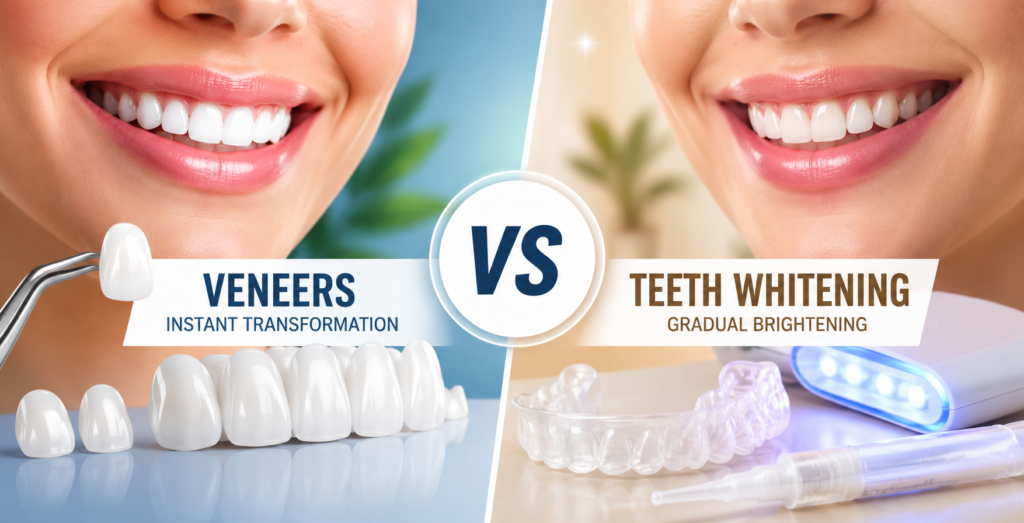
Whitening is usually the ideal choice and costs significantly less than the alternative if your teeth are otherwise healthy but discolored. If you’re dealing with chips, gaps, permanent discoloration, or worn edges, whitening won’t touch those problems, and veneers become the real answer. That’s the short version. The rest of this guide walks through the cost differences, how long each lasts, what the trade-offs actually feel like in your mouth, and how to decide without wasting money on the wrong fix. Both treatments improve the appearance of your smile. That’s where the similarity ends.
What Each Treatment Actually Does to Your Teeth
Teeth whitening removes stains from the surface and just below the enamel using peroxide-based gels. Professional in-office treatments use hydrogen peroxide concentrations between 25% and 40%, while take-home trays from a dentist use carbamide peroxide, usually 10% to 22%. According to the American Dental Association, whitening works well on yellow-toned stains from coffee, tea, wine, and age. Still, it does nothing for the tooth’s shape, position, or structural flaws.
Veneers are slender layers of porcelain or composite material attached to the visible surface of the teeth. Porcelain veneers are about 0.5mm thick and require your dentist to remove a small amount of enamel first. Once the enamel is gone, it doesn’t grow back, so they’re permanent. That single fact changes the entire decision, as whitening is reversible and non-invasive. Veneers are a lifetime commitment to maintaining restorations.
The Money Question: Real Costs Compared
Price is usually the deciding factor, so here’s what the numbers look like in the Denver area and nationally.
| Treatment | Typical Cost (Per Tooth or Session) | Lasts | Reversible? |
| In-office whitening | $400–$800 per session | 6 months–2 years | Yes |
| Take-home professional trays | $250–$500 | 6 months–1 year | Yes |
| Composite veneers | $400–$1,500 per tooth | 5–7 years | Sometimes |
| Porcelain veneers | $1,000–$2,500 per tooth | 10–15 years | No |
A full smile makeover with porcelain veneers covering the top eight visible teeth can run $8,000 to $20,000. Whitening your whole smile costs less than a single veneer. The American Academy of Cosmetic Dentistry notes that porcelain veneers, while expensive upfront, often last over a decade with proper care. The per-year cost narrows over time, but the initial outlay is steep.
Insurance rarely covers either one. Both are considered cosmetic, so most dental plans won’t cover them unless a veneer is used to restore a genuinely damaged or broken tooth.
A Real Scenario: Two Patients, Two Right Answers
Picture two people sitting in the same waiting room.
The first is a 34-year-old who drinks three coffees a day and noticed her teeth looking dull in photos. Her teeth are straight, unchipped, and healthy, just stained. For her, spending thousands on veneers would be overkill. A professional whitening session brightens her smile several shades for a few hundred dollars, and she maintains it with occasional take-home touch-ups.
The second patient chipped a front tooth years ago, has a noticeable gap, and has deep grayish discoloration from a childhood antibiotic. Peroxide whitening can’t close a gap or repair a chip, and tetracycline stains barely respond to bleaching. Veneers solve all three problems at once. Same room, completely different treatments, both correct.
Where People Waste Their Money
The most expensive mistake is choosing veneers when whitening would have worked. People see a celebrity smile online, assume they need veneers, and commit to permanently altering healthy teeth when a $500 whitening treatment would have delivered what they actually wanted. Once enamel is removed, there’s no way to go back. Those teeth will need veneers or crowns for life.
The reverse mistake is cheaper but frustrating: buying drugstore whitening strips expecting them to fix intrinsic stains, chips, or old fillings. According to the FDA, over-the-counter whitening products are safe when used as directed, but they only address surface staining. If your discoloration comes from inside the tooth, from trauma, medication, or root canal work, no strip will help. You’ll spend months and see nothing.
What a Dentist Would Actually Recommend
Start with the least invasive option that solves your problem. If your teeth are structurally sound and the only issue is color, try professional whitening first. It’s affordable, reversible, and often the whole answer. You can always escalate to veneers later. You can’t un-remove enamel.
Reach for veneers when you’re dealing with shape, spacing, permanent discoloration, or damage that whitening physically cannot address. If you want both a whiter shade and a corrected shape, whiten any natural teeth first, then match the veneers to that brighter color because veneers don’t respond to bleaching gel once they’re placed. Get the sequence wrong and you’ll have bright natural teeth next to older, dimmer restorations.
The Bottom Line for Your Smile
Veneers vs Teeth Whitening aren’t competitors. They fix different problems. If you’re picking between them, the deciding factor isn’t budget or trends; it’s whether your teeth need better color or better structure. Color problems get whitening. Structural problems get veneers. When it’s both, they work together in the right order.
If you’re in the Denver area and still unsure which path is right for your teeth, the team at Broadway Family Dentists can assess your enamel, staining type, and goals in a single consultation. Give you a straight answer, often the same day. Book an evaluation before committing to any permanent change, and you’ll spend money once, on the right fix.