







The evolution of dental technology has converted the field from an old, simple and painful treatment to a precise and widely used treatment. Moving from ancient tools to the modern era of AI ( artificial intelligence) and 3D printing is a journey of a thousand years.
Laser dentistry is becoming popular in 2026 because it provides a convenient treatment for teeth. It has minimal discomfort, faster recovery and high precision. This blog contains comprehensive information about advanced dental laser technology.
What Is Advanced Dental Laser Technology 2026?
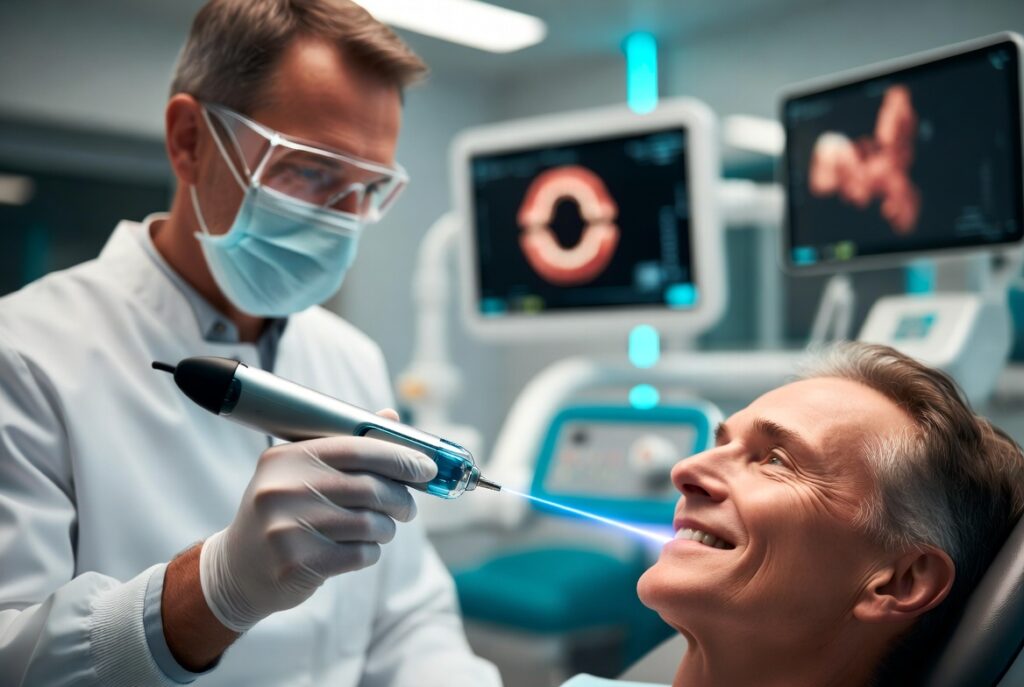
Advanced dental laser technology 2026 uses a focused light energy at a specific wavelength to treat hard and soft tissues with high precision. The need for drills in the treatment is also reduced.
How Dental Laser Work?
A dental laser works as a cutting or vaporizing instrument for hard (teeth) and soft (gums) tissues by providing focused light energy. These instruments reduce bleeding and pain by using specific wavelengths absorbed by water, hemoglobin or hydroxyapatite. Hemoglobin (Hb) is an iron-rich protein in red blood cells. It transports oxygen from the lungs to body tissues and returns carbon dioxide to the lungs.
Types Of Dental Lasers
Dental lasers are categorized into three main kinds, depending on their wavelength and target absorption which are given below.
Hard tissue (bone/teeth) Dental Lasers
These types of dental lasers are used for precise and pain free dentistry. They remove decayed tooth structure, prepare cavities and shape bone without the noise and vibration of a drill.
Soft Tissue (gums) Dental Lasers
These are diode lasers which are specially handheld devices. They emit focused light energy to cut, vaporize or reshape gingival tissue(gems), bacteria and infected parts with high precision.
All tissue Dental Lasers
They are the devices that are used to treat both hard and soft tissues. They use specific wavelengths that are highly absorbed by water and hydroxyapatite and are mineral component of teeth and bone.
Key Benefits of Dental Laser Technology in 2026
Dental laser technology has become an important part of modern, patient-centered dentistry which provides high precision and less painful treatment.
- It is a pain-free and comfortable solution for you if you are conscious about your dental treatment.
- It reduces swelling and controls bleeding to a minimum level.
- It protects the healthy tissues of the body and targets only the affected areas of your body.
- It also reduces the danger of infection by destroying harmful bacteria.
Use of Laser Technology In Teeth Treatment
Cavity Detection and Treatment
It is a process in which laser technology scans your teeth with harmless laser light. It provides a highly accurate detection of tooth decay. It also recognizes the hidden, subsurface demineralization with the help of fluorescence, which helps preventive treatment before structural damage.
Gum Disease Treatment
Laser technology is also helpful in the treatment of gum disease as it uses light energy to eliminate bacteria. It supports faster healing, reduces pain and triggers tissue regeneration to reattach to gums and teeth.
Teeth Whitening
Teeth whitening with the help of laser is a fast and in-office cosmetic procedure that makes your teeth 4 to 8 shades lighter in about an hour. It is an easy process in which a dentist applies a high-concentration peroxide gel on your teeth and activates it with a laser to accelerate stain breakdown.
Root Canal Therapy
Root canal therapy is a dental procedure that is used to save a damaged tooth. In this process, damaged pulp is removed, the canals are cleaned and then sealed.
How Dental Laser Technology Is Transforming Patient Experience
Dental laser technology is transforming the experience of patients by shifting from traditional, painful methods to less painful methods, high precision procedures that significantly improve comfort, safety and recovery times.
Advanced Features of Dental Laser Technology in 2026
AI Integration in Laser Density
It refers to a laser energy density or power density optimization. These systems can move beyond traditional methods to achieve real-time control and higher precision material density with the help of machine learning and deep learning.
Less Invasive Techniques
Laser density treatments are advanced and non-surgical methods which are used to reduce fat, tighten skin and improve structure without the need for cutting, stitches or significant downtime. These treatments work by providing controlled energy into the dermal layer to increase collagen production and make your skin better from within.
Digital Dentistry Combination
Digital surgery combines advanced robotic platforms, artificial intelligence (AI) and data analytics which improve surgical precision and patient outcomes. It also shows clear, detailed and sharp images and videos during treatment.
Traditional Dentistry vs Laser Dentistry
Traditional dentistry refers to the old methods that are used to treat dental problems such as cavities, gum disease and tooth damage. Laser dentistry refers to the latest techniques used to treat your dental problems. It uses light energy instead of drills to reduce bleeding, swelling and faster healing times.
Why Dental Laser Technology Is Limited?
Dental laser technology is limited because it is not suitable for all cases. It is limited due to the higher cost. It requires skilled professionals which is the main cause of its limitation. It is also limited due to a lack of availability.
Conclusion
The expanding realm of laser dentistry refers to a bright future. Laser dentistry will be more efficient, precise and patient-friendly in the future. The new developments in laser dentistry promise to reduce dental problems such as cavities and gum disease. If you want to get more information about dental laser technology and its advancement, Broadway Family Dentists is a known platform that provides all the information about dental laser technology.